बुधबार १४ असोज, २०८३,
Wed, 30 Sep, 2026
बुधबार १४ असोज, २०८३,
Wed, 30 Sep, 2026
Nepali cooperative sector has undergone a sea change since the noble idea was formalized and institutionalized from the government in 2010 (2954 AD) with the formation of Department of Cooperatives and 2013 (1957AD) with the establishment of Bakhan Credit Cooperative at Chitwan. However, the ritual of official celebration as National Cooperative Day commenced in commemoration of the formation of the first cooperative. More than six-and-a-half-decade history of the formal cooperative beginning in the 'land of cooperatives' has successfully weathered waves, tides and typhoons. Consequently, we have been able to celebrate the celebrating the 66th National Cooperative Day.
This year, the National Cooperative Federation of Nepal (NCF), the apex body of all the cooperatives of Nepal, has set the theme 'Sustainability of Cooperatives: Self-Regulation and Good Governance.' The theme has shouldered the burden of the movement in a very apt sense as several questions have been raised by the people from different walks of life about the sector's durability and longevity citing a handful of instances of cooperative failures. But the movement with the strongest social network of more than 7 million members, more than 91 thousand direct employment opportunities from the 30,000 plus cooperatives, will have to demonstrate its might once again and the put the questions to an end. We are all aware that there are cooperatives operating in various sectors in our country but financial cooperatives occupy the biggest share and are by nature, sensitive too. Amid volatile financial landscape, global recession and strong rivalry among power-hungry nations, credit cooperative of our country are hit hard. In this, context what we, as cooperators, can do is to manifest ever more resilience to fight back to the anomalies, purify our practices and get going. Here are the significant challenges, impediments and strategic hurdles that savings and credit cooperatives (SACCOS) in Nepal currently face. However, these hiccups are nothing to panic about, if dealt with sincere cautiousness, collective endeavor and perseverance.
Regulatory Challenges: The regulatory framework for SACCOS in Nepal is weak, there are some ambiguities which lead to issues such as lack of standardization and transparency in financial reporting, difficulty in accessing funds, and challenges in maintaining member data confidentiality. A separate statutory provision for SACCCOS would genuinely bring most of the governance issues under control and direct their courses towards operational efficiency, financial prudence and member centricity. International instances have proved that financial cooperatives administered via separate act have better served members and proved their communal attachment.
Financial Challenges: Most SACCOS face challenges in managing their finances, including difficulty in mobilizing savings, providing loans, and managing multitude of risks. Lack of access to adequate capital and difficulty in attracting external investment is also significant issues. Questions regarding the worthiness of the various funds that have to be fed with the annual surplus have also been raised.
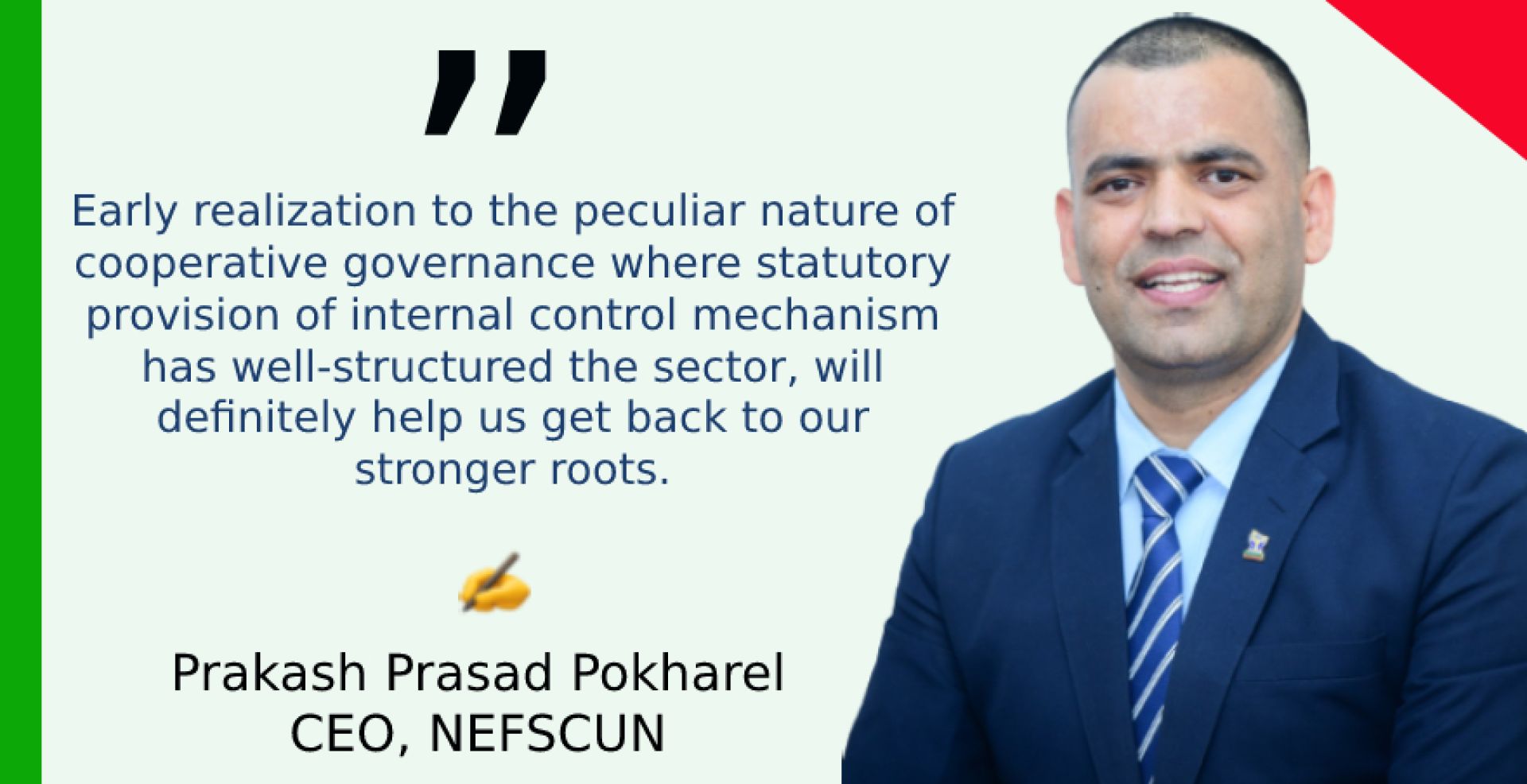
Governance Challenges: SACCOS often lack effective governance structures, leading to issues such as weak internal controls, fraud, and mismanagement. The role of the Account Supervisory Committee has been overshadowed due to lack of realization of its gravity, ignorance and suppression from the Board. That is why the issue of misappropriation of the members' hard earned money, reluctance to implement succession strategy, fit and proper test, etc. have surfaced in the sector. If the system of check and balance is duly disciplined via internal control system, majority of the problems get resolved. It also lessens the so-called trespassing of the regulators. Early realization to this peculiar nature of cooperative governance where statutory provision of internal control mechanism has well-structured the sector, will definitely help us get back to our stronger roots.
Technological challenges: Many SACCOS lack necessary technological infrastructure and expertise to keep up with the rapidly changing financial landscape. This makes it difficult to provide efficient and effective financial services to their members. No access of national payment platform (depend on financial institution to connection), Cyber security and lacking of data security having CBS standardization, quality and security audit.
Demographic Challenge: Achieving demographic dividend is one of the major impediments of our country that has pushed us back in the development front. In the cooperative sector also the side effects are more than obvious. Although we proclaim that the participation of women in our sector is more than the male demography, but we have not been rest assured that women have a real say in the decision making level. And most importantly, the missing generation of the constitutionally recognized pillar of the national economy is the active engagement and mobilization of the youth demography. Until and unless we cater to the wills and aspirations of the instant, prompt and techno-savvy Generation Z, we cannot bring the desired outcome of encompassing the vibrant human capital to our sector. The financial cooperative sector has the daunting task of enrolling the nation builders of tomorrow and be their change-agents.
Stiff Competition: SACCOs face tough competition from industry allies as well other financial institutions, including banks and microfinance institutions. This competition can lead to issues such as margin compression, loss of market share, and difficulty in attracting new members. Within the industry actors also we have seen unhealthy competitions, but what we must not forget is that it is not through competition but through cooperation we can achieve our goals and objectives. The financial cooperative sector has to acknowledge the explicit truth that beauty of cooperatives lies in cooperation rather than competition.
Way Forward: It might sound cliché, but problems come carrying solutions too. The cooperative sector that has dealt with all sorts of difficulties in the past will bounce back stronger. Integration of cooperative with national financial system, integrated/shared network development; credit union act with financial framework and having financial instrument provision owned by the central bank, strong unified Enterprise Resource Planning (ERP) inbuilt with safe digital banking solution, strong monitoring/supervision mechanism, set up of much-awaited Second Tier Institution (STI) and obedience to good governance. Ultimately, this year's theme also emphasizes on transforming the cooperative, especially financial cooperative sector abiding by the forever relevant mantras of self-help, self-governance and self-responsibility. Getting back into shape and even better positioning requires strong determination, firm commitment, visionary leadership and skilled workforce that will strategize collectively to achieve common goals of 'Prosperous Nepal, Happy Nepali.'



सञ्चार रजिष्ट्रारको कार्यालय दर्ता प्रमाणपत्र नंः
००१७६/०७९-०८०






.jpg)